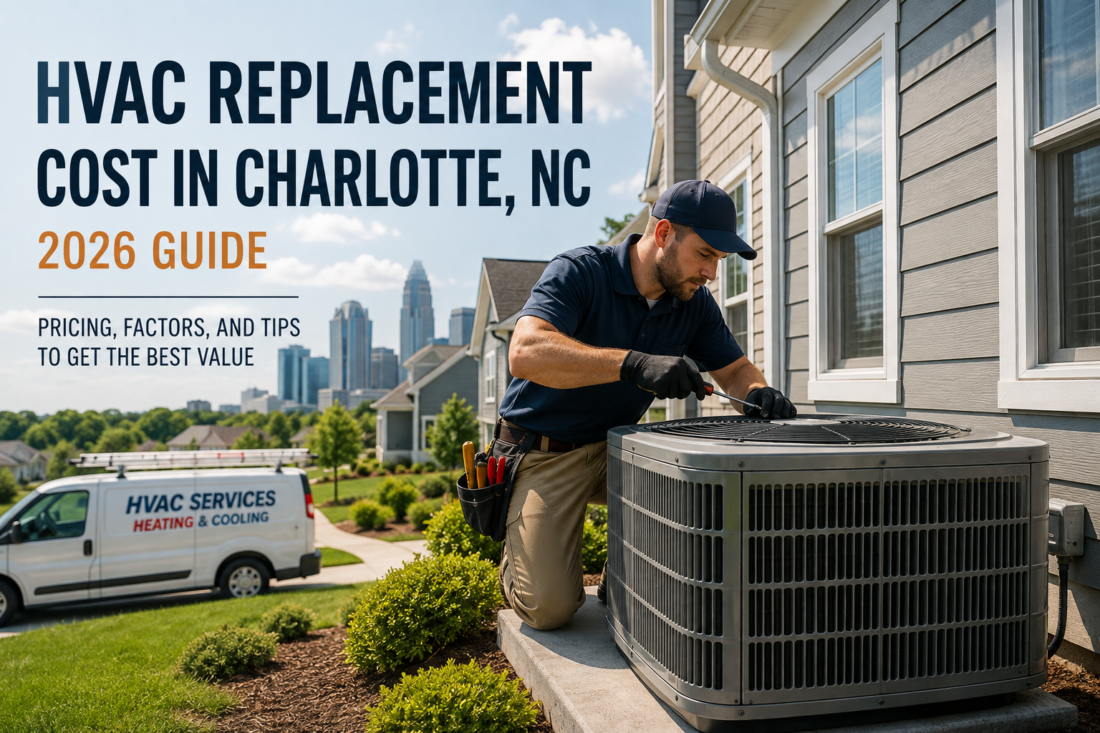
Replacing an HVAC system is a major home expense, and Charlotte homeowners can face very different prices depending on the type of system, equipment size, efficiency, installation requirements, and condition of the existing ductwork.
How much does HVAC replacement cost in Charlotte?
For a typical residential HVAC replacement in Charlotte, homeowners can expect to budget roughly $6,000 to $12,000 when new ductwork is not required. Smaller or simpler replacements may cost less, while high-efficiency equipment, heat pumps, difficult installations, ductwork changes, or other upgrades can push the project above this range.
For a typical HVAC replacement in Charlotte, NC, homeowners can generally expect to budget about $6,000 to $12,000 when existing ductwork can be reused. Current Charlotte cost data puts the average replacement project at roughly $7,298, although actual quotes can fall below or above that range depending on the project.
If new ductwork, electrical modifications, difficult installation conditions, zoning, or other major work is required, the total can increase significantly.
The most reliable way to determine your actual HVAC replacement cost is to have a qualified local contractor inspect the home and provide a detailed estimate. If you’re planning an HVAC project, you can also explore HVAC services in Charlotte to learn more about available services and contractor options.
HVAC Replacement Cost in Charlotte at a Glance
| HVAC Project | Typical Charlotte Cost Range |
|---|---|
| Complete HVAC replacement | $6,000–$12,000 |
| Furnace replacement | $3,700–$7,000 |
| Central AC replacement | $3,800–$7,100 |
| Heat pump installation | $3,900–$7,500 |
| HVAC replacement with new ductwork | $9,000–$20,000+ |
| Ductwork replacement | $1,400–$9,000+ |
What Is Included in an HVAC Replacement?
A replacement quote may include much more than the equipment itself.
Depending on your home and system, the project may include:
- New indoor air-handling or furnace equipment
- Outdoor AC condenser or heat-pump unit
- Installation labor
- Refrigerant-line connections
- Electrical connections
- Thermostat installation
- Condensate drainage
- Equipment removal and disposal
- Startup and system testing
- Permits and inspections
- Minor ductwork modifications
Some estimates may include nearly all of these items, while others may list equipment and labor separately.
That is why comparing the total scope of work, rather than simply choosing the lowest advertised price, is important.
What Factors Affect HVAC Replacement Cost in Charlotte?
The price of an HVAC replacement is not determined by the equipment alone. Two homes in Charlotte can receive very different quotes for what appears to be a similar replacement because of differences in system size, efficiency, ductwork, installation conditions, and the amount of work required.
1. System Size and Home Requirements
The size of the HVAC system is one of the biggest factors affecting price. A larger home may require more cooling and heating capacity, but contractors should not simply choose a larger unit based on square footage alone.
A proper load calculation considers factors such as the home’s size, insulation, windows, orientation, ceiling height, and other characteristics before determining the appropriate equipment capacity.
For example, current Charlotte data indicates that a median-size home may require roughly 2.5 to 3.5 tons of cooling capacity, but the correct size varies from home to home.
2. Equipment Efficiency
Higher-efficiency HVAC equipment generally costs more upfront.
Homeowners may encounter different efficiency levels and equipment configurations when comparing quotes. Higher-efficiency systems can reduce energy consumption, but the additional upfront cost does not necessarily make the highest-efficiency option the best choice for every home.
Ask contractors to provide the equipment model, efficiency rating, warranty, and expected installation cost in the written proposal so you can compare similar systems.
3. Ductwork Condition
Existing ductwork can have a significant effect on the final price.
If ducts are leaking, damaged, poorly insulated, undersized, or difficult to access, the contractor may recommend repairs or replacement. Ductwork problems can also reduce the performance of a new HVAC system.
This is why homeowners should ask whether ductwork inspection and any recommended repairs are included in the quote.
4. Installation Complexity
Not every HVAC replacement is a simple equipment swap.
Installation can become more expensive when equipment is located in a difficult attic or crawl space, when electrical modifications are needed, when the equipment location must be changed, or when additional code-related work is required.
A quote that appears more expensive may therefore include substantially more installation work than a lower quote.
5. Permits and Local Requirements
HVAC replacements in Charlotte require permitting, and permit costs can vary depending on the project. Current Charlotte estimates put typical HVAC replacement permits at roughly $60–$150.
In most cases, the contractor handles the permit and inspection process and includes the associated cost in the project estimate.
6. Labor and Contractor Experience
Labor is another important part of the total replacement price.
Charlotte HVAC contractors may charge different rates depending on experience, project complexity, demand, and the amount of installation work required. During periods of high cooling demand, homeowners may also encounter higher pricing or longer scheduling times.
Rather than choosing a contractor solely because of the lowest price, compare what each quote actually includes.
How Much Does a Furnace and AC Replacement Cost in Charlotte?
For homeowners replacing both the furnace and central air conditioner, current Charlotte estimates put the typical project around $4,865 to $12,163, with an average of approximately $7,298.
The actual price can vary based on:
- Furnace efficiency
- AC efficiency
- Equipment size
- Brand
- Ductwork
- Electrical requirements
- Installation complexity
- Warranty
- Contractor labor
If both systems are old and approaching the end of their useful lives, replacing them together may be worth considering rather than replacing one component and waiting for the other to fail.
However, homeowners shouldn’t automatically replace both systems.
If one component is relatively new and in good condition, replacing only the failed component may make more financial sense.
How Much Does a Heat Pump Replacement Cost in Charlotte?
Heat pumps deserve special consideration in Charlotte because they can provide both heating and cooling.
Current Charlotte estimates place many heat-pump installations around $6,000–$14,000, although the range varies by system type, capacity, efficiency, and installation requirements.
A heat pump may be particularly attractive to homeowners who want one system to handle both heating and cooling.
However, the best choice depends on the home’s existing system, electrical setup, insulation, ductwork, comfort requirements, and budget.
Does New Ductwork Increase HVAC Replacement Cost?
Yes.
If the existing ductwork is damaged, undersized, poorly sealed, or incompatible with the new equipment, replacement or modification may be necessary.
Current Charlotte estimates place new ductwork installation at roughly $3,000–$7,000, although the actual cost depends heavily on the size and accessibility of the duct system.
Before accepting an HVAC replacement quote, ask:
Does this price include ductwork inspection and any required modifications?
That one question can prevent a surprisingly large difference between an initial estimate and the final project cost.
Does HVAC Replacement Require a Permit in Charlotte?
HVAC replacement can involve permits and inspections, and permit requirements depend on the specific work being performed and local regulations.
Current Charlotte cost research estimates typical HVAC replacement permits at approximately $60–$150, but homeowners should ask the contractor whether required permits are included in the quoted price.
A professional contractor should be able to explain what permits are required for your project.
Should You Repair or Replace Your HVAC System?
Replacing an HVAC system is a significant investment, so replacement is not automatically the best choice whenever something goes wrong. In some cases, a relatively inexpensive repair can extend the life of an otherwise reliable system.
On the other hand, continuing to repair an older system can become expensive when major components begin failing or the system no longer provides reliable heating and cooling.
When Repairing May Make More Sense
Repair may be the better option when:
- The HVAC system is relatively new or has otherwise been reliable.
- The problem is limited to a single component.
- The repair cost is relatively small compared with replacement.
- The system still provides adequate heating and cooling.
- Energy bills and system performance have remained reasonably stable.
- The contractor expects the repair to provide a reasonable amount of additional service life.
Charlotte HVAC repair costs vary considerably depending on the problem. A relatively minor repair may make financial sense when the rest of the system is in good condition.
When Replacement May Make More Sense
Replacement deserves serious consideration when:
- The system is older and requires increasingly frequent repairs.
- Major components such as the compressor, heat exchanger, or coil are failing.
- The system struggles to maintain comfortable temperatures.
- Energy costs have increased because of declining efficiency.
- Replacement parts are becoming difficult or expensive to obtain.
- The existing system uses outdated technology or refrigerant.
- A major repair would represent a significant portion of the cost of a new system.
Age alone should not automatically determine whether an HVAC system needs replacement. A well-maintained system may continue operating reliably, while a poorly maintained system may require replacement sooner.
A Simple Way to Compare Repair and Replacement
Instead of using a single rule such as “replace any system over 10 or 15 years old,” compare the expected repair cost with the condition and expected remaining life of the system.
For example, spending several hundred dollars to repair a system that is otherwise performing well can make sense. A much larger repair on an aging system may be harder to justify if other components are also approaching the end of their useful life.
Ask the contractor to provide both options when practical:
Repair option: What is failing, what will the repair cost, and how long might the repair reasonably extend the system’s service life?
Replacement option: What would a complete replacement cost, what equipment would be installed, what efficiency rating would it have, and what installation work is included?
Comparing both options can make the decision much clearer.
How to Compare HVAC Replacement Quotes
Getting multiple HVAC estimates can help you understand whether a proposed price is reasonable, but comparing quotes only by the total price can be misleading.
A lower quote may leave out important work, while a higher quote may include better equipment, additional installation work, a longer warranty, or ductwork modifications.
Get at Least Three Quotes
When possible, request estimates from at least three qualified HVAC contractors.
Ask each contractor to evaluate the same project so that you can compare similar equipment and installation requirements.
Make Sure Each Quote Includes the Equipment Model
A quote should identify the manufacturer and specific model numbers of the proposed equipment.
This allows you to compare efficiency ratings, capacity, warranty coverage, and equipment specifications rather than simply comparing brand names.
Check the System Size
The contractor should explain how the proposed system size was determined.
A professional HVAC contractor should consider the characteristics of your home rather than selecting equipment based only on square footage. A Manual J load calculation can help determine the appropriate heating and cooling capacity.
Oversizing a system is not necessarily better. An improperly sized system can affect comfort, efficiency, and humidity control.
Check What Installation Work Is Included
Ask whether the quoted price includes:
- Removal and disposal of the existing equipment
- New indoor and outdoor equipment
- Thermostat
- Refrigerant-related work
- Electrical modifications, if required
- Ductwork repairs or modifications
- Condensate drainage work
- Equipment startup and testing
- Required permits and inspections
- Labor
- Cleanup and disposal
This is one of the easiest ways to discover why two contractors have very different prices.
Compare Efficiency Ratings
Don’t compare two HVAC systems solely by brand.
Look at the actual efficiency ratings and model numbers listed in each proposal. Higher-efficiency equipment generally costs more upfront, so compare the additional cost against your expected energy savings and how long you expect to remain in the home.
Ask About Warranties
Ask each contractor to clearly explain:
- Equipment warranty
- Compressor warranty
- Parts warranty
- Labor warranty
- What could void the warranty
- Whether registration is required
A lower-priced installation may not be the better value if warranty coverage is significantly weaker.
Verify Licensing and Insurance
Before hiring a contractor, verify that the company is properly licensed and insured.
North Carolina HVAC contractors are regulated by the North Carolina State Board of Examiners of Plumbing, Heating and Fire Sprinkler Contractors. Contractors and technicians who handle refrigerants also need to meet applicable federal requirements.
Don’t Automatically Choose the Lowest Quote
The cheapest estimate isn’t necessarily the best deal.
Instead, compare the equipment, installation scope, warranty, contractor qualifications, and total project cost.
A slightly higher quote may provide better equipment or include installation work that another contractor has excluded.
What a Good HVAC Quote Should Tell You
A useful written estimate should make it possible for you to understand exactly what you’re paying for.
Before signing a contract, make sure the proposal clearly identifies the equipment, system size, efficiency rating, installation work, warranty coverage, permits, payment terms, and total price.
If two quotes are dramatically different, ask both contractors to explain the difference before making a decision.
How to Get a More Accurate HVAC Replacement Estimate in Charlotte
Online cost ranges are useful for budgeting, but they cannot replace an inspection of your home.
A qualified HVAC contractor can evaluate:
- Existing equipment
- Home size
- Ductwork
- Insulation
- Electrical requirements
- Equipment location
- Load requirements
- Comfort problems
- Existing system condition
You can then compare detailed proposals rather than trying to estimate the entire project from an online calculator.
Questions to Ask Your HVAC Contractor Before Signing
Before choosing an HVAC contractor, ask a few specific questions to make sure you understand what you are paying for and what is included in the installation.
1. What size HVAC system does my home need?
Ask the contractor how they determined the required system capacity.
The recommended size should be based on the characteristics of your home and its heating and cooling requirements rather than simply choosing a larger system because the home has more square footage.
2. What equipment model are you recommending?
Ask for the exact manufacturer and model numbers of the proposed equipment.
This allows you to compare efficiency, capacity, warranty coverage, and equipment specifications between different contractors.
3. Does the quote include removal of my old system?
Confirm whether the estimate includes removing and disposing of the existing furnace, air conditioner, heat pump, or other equipment.
4. Is ductwork included?
Ask whether the contractor has inspected the existing ductwork and whether repairs, modifications, sealing, or replacement are included in the quoted price.
If ductwork work is recommended, ask for it to be listed separately in the proposal.
5. Are permits and inspections included?
Ask who will obtain the required permits and whether permit and inspection costs are included in the quoted price.
6. What warranties are included?
Ask about both equipment and labor warranties.
Find out how long each warranty lasts, what it covers, whether registration is required, and whether there are exclusions you should know about.
7. Is the contractor properly licensed and insured?
North Carolina requires licensing for contractors who engage in HVAC contracting, subject to the state’s applicable exemptions and classifications. You can verify a contractor’s license through the North Carolina State Board of Examiners of Plumbing, Heating and Fire Sprinkler Contractors.
Ask the contractor for their license information and verify it before signing a contract.
8. What is the total price?
Ask for a written, itemized proposal showing the equipment, installation work, permits, accessories, warranties, and total project price.
Avoid relying only on a verbal estimate.
9. What happens if additional work is discovered?
Ask how unexpected work will be handled.
A good proposal should explain whether additional work requires your approval before the contractor performs it and how those additional charges will be calculated.
10. What maintenance will the new system require?
Ask the contractor what routine maintenance is recommended and whether they offer a maintenance plan.
Understanding future maintenance requirements can help you estimate the long-term cost of owning the system.
Taking the time to ask these questions can make it easier to compare HVAC contractors based on the complete value of their proposals rather than choosing a company based only on the lowest initial price.
Ready to Replace Your HVAC System?
Get estimates from local Charlotte HVAC professionals and compare your options before choosing a contractor.
Get Free HVAC QuotesHVAC Replacement Cost in Charlotte: Bottom Line
For many Charlotte homeowners, budgeting approximately $6,000–$12,000 is a reasonable starting point for a conventional HVAC replacement when existing ductwork can be reused. A current Charlotte estimate puts the average replacement project around $7,298.
Projects involving new ductwork, major electrical work, difficult access, higher-efficiency equipment, or premium systems can cost substantially more.
The best approach is to compare several detailed estimates and look beyond the headline price.
The right HVAC system should be properly sized for your home, appropriate for Charlotte’s climate, professionally installed, and supported by a clear warranty.
Frequently Asked Questions
How much does HVAC replacement cost in Charlotte?
A typical HVAC replacement in Charlotte can cost approximately $6,000–$12,000 when existing ductwork can be reused. Larger or more complex projects can cost considerably more.
How much does it cost to replace a furnace and AC in Charlotte?
Current Charlotte estimates put furnace-and-AC replacement at approximately $4,865–$12,163, with an average around $7,298.
Is it cheaper to repair or replace an HVAC system?
Repair is usually less expensive in the short term, but replacement may provide better long-term value when an older system requires frequent or expensive repairs. The right choice depends on the system’s age, condition and repair history.
How many HVAC quotes should I get?
For a major HVAC replacement, getting around three detailed estimates gives you a useful basis for comparing equipment, installation scope, warranties and pricing.
Does new ductwork make HVAC replacement more expensive?
Yes. New ductwork can add several thousand dollars to a project. Current Charlotte estimates put ductwork installation around $3,000–$7,000, depending on the home’s layout and installation complexity.
Are heat pumps a good option for Charlotte?
Heat pumps can be a strong option for Charlotte because they provide both heating and cooling and are well suited to the region’s relatively mild winters. The best system depends on the home’s characteristics and the homeowner’s budget and comfort goals.
How We Estimate HVAC Replacement Costs
CarolinaHomesPro uses Charlotte-area cost data and current industry pricing information to provide planning ranges for homeowners. Actual contractor prices vary by equipment, home size, installation requirements, labor, permits, and project complexity. We recommend comparing multiple written estimates before making a replacement decision.
1 thought on “How Much Does HVAC Replacement Cost in Charlotte, NC? (2026 Guide)”