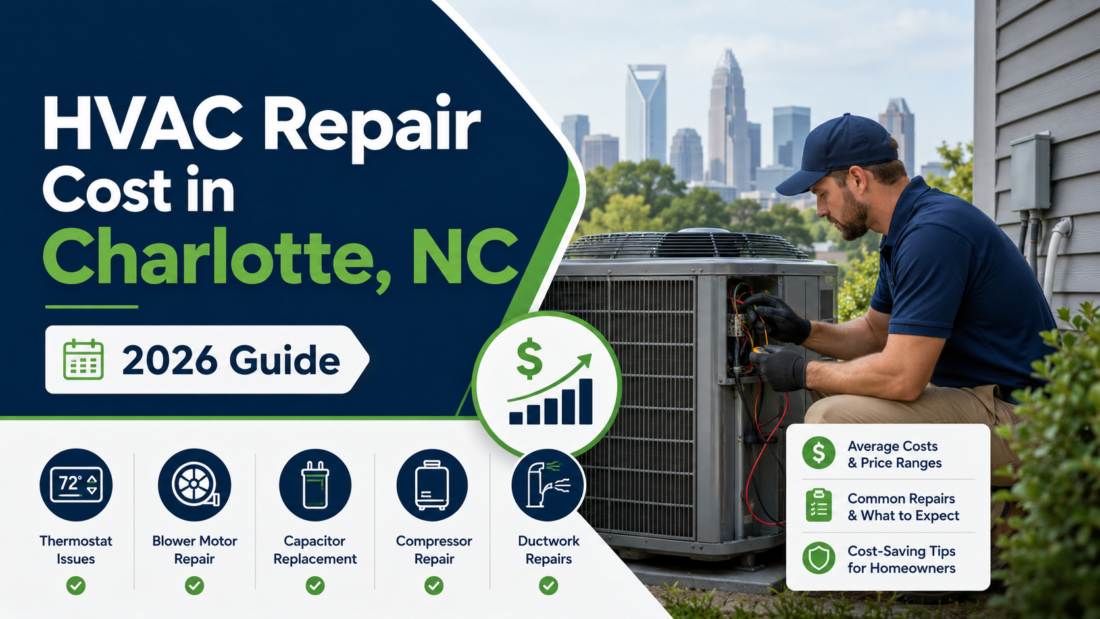
When your heating or cooling system develops a problem, the first question is usually simple:
How much is this HVAC repair going to cost?
For homeowners in Charlotte, NC, the answer can range from a relatively inexpensive service call or capacitor replacement to a much larger repair involving a blower motor, compressor, refrigerant system, control board, or ductwork.
The final price depends on the type of system, the failed component, labor requirements, accessibility, equipment age, parts availability, and whether the problem occurs during a high-demand season.
This guide explains typical HVAC repair costs in Charlotte in 2026, what affects pricing, which repairs are commonly needed, and when replacing an aging system may make more financial sense than continuing to repair it.
HVAC Repair Cost in Charlotte at a Glance
Typical HVAC repair costs can vary considerably depending on the issue.
| HVAC Service or Repair | Typical Planning Range |
|---|---|
| HVAC service call / diagnostic visit | $95–$245 |
| AC tune-up | $70–$195 |
| Capacitor replacement | $95–$245 |
| Contactor replacement | $120–$300 |
| Thermostat replacement | $145–$340 |
| Condensate drain repair | $100–$350 |
| Circuit board replacement | $200–$650 |
| Fan motor replacement | $250–$700 |
| Blower motor replacement | $350–$1,000+ |
| Refrigerant leak repair | $250–$1,500+ |
| Evaporator coil repair or replacement | $700–$2,500+ |
| Compressor replacement | $1,500–$3,500+ |
| Heat exchanger replacement | $1,000–$3,000+ |
| Duct repair | $485–$1,950+ |
| Major ductwork replacement | $1,400–$9,000+ |
These figures are useful planning ranges rather than guaranteed contractor prices. The actual amount can be lower or higher depending on your equipment and the work required.
What Is Included in an HVAC Repair Cost?
An HVAC repair bill usually includes more than the replacement part itself.
A contractor may charge for:
- Diagnostic inspection
- Technician labor
- Replacement parts
- Refrigerant, if required
- Electrical testing
- System testing after the repair
- Travel or service-call charges
- Emergency or after-hours service
- Disposal of damaged components
- Additional troubleshooting when multiple issues are present
Some contractors apply the diagnostic fee toward the repair if you approve the work, while others charge the service call separately.
Ask what is included before authorizing the repair.
How Much Does an HVAC Service Call Cost in Charlotte?
A typical HVAC service or diagnostic visit may cost approximately:
$95–$245
The technician generally inspects the system, identifies the likely cause of the problem, and provides a repair estimate.
A diagnostic visit may involve checking:
- Thermostat operation
- Electrical connections
- Capacitors and contactors
- Blower operation
- Outdoor condenser operation
- Refrigerant pressures
- Airflow
- Filters
- Drain lines
- Safety controls
The service-call price usually does not include major replacement parts.
How Much Does AC Repair Cost in Charlotte?
Air-conditioning repair costs vary greatly depending on which component has failed.
Simple repairs may cost only a few hundred dollars, while compressor, coil, or refrigerant-related problems can become considerably more expensive.
Charlotte homeowners commonly encounter AC problems involving capacitors, contactors, drain lines, condenser fans, blower motors, control boards, refrigerant leaks, and compressors.
AC Capacitor Replacement Cost
A capacitor helps provide the electrical energy required for certain HVAC motors to start and operate correctly.
A typical capacitor replacement may cost around:
$95–$245
Signs of a failed capacitor can include:
- Outdoor unit not starting
- Humming noises
- Fan not spinning
- Intermittent cooling
- System shutting down unexpectedly
Capacitors are generally one of the less expensive AC repairs.
AC Contactor Replacement Cost
The contactor controls electrical power to components inside the outdoor unit.
A typical replacement may cost approximately:
$120–$300
A damaged contactor can prevent the condenser from starting or cause unreliable operation.
Thermostat Replacement Cost
A thermostat problem can sometimes look like a more serious HVAC failure.
Typical thermostat replacement costs may range from:
$145–$340
More advanced smart thermostats can cost more depending on the model and installation requirements.
Before replacing major HVAC equipment, it is worth confirming that the thermostat and its wiring are functioning properly.
HVAC Circuit Board Replacement Cost
Modern HVAC systems rely on electronic control boards to manage various system functions.
A circuit board replacement may typically cost:
$200–$650 or more
The price depends heavily on:
- Equipment manufacturer
- Model
- Board availability
- System complexity
- Labor required for diagnosis and installation
Older equipment can sometimes become expensive to repair simply because replacement electronic components are difficult to obtain.
HVAC Fan Motor Replacement Cost
Fan motors are used in both indoor and outdoor HVAC equipment.
Depending on the motor, typical repairs may range from:
$250–$700
More advanced variable-speed motors can cost considerably more than standard motors.
Symptoms may include:
- Fan not spinning
- Weak airflow
- Overheating
- Unusual noises
- System shutting off
- Outdoor condenser operating incorrectly
Blower Motor Replacement Cost
The indoor blower moves conditioned air through your home’s ductwork.
Typical blower motor replacement may cost approximately:
$350–$1,000+
Variable-speed and electronically commutated motors can be significantly more expensive.
A failing blower motor may cause:
- Weak airflow
- No airflow
- Loud operation
- Burning smells
- Intermittent operation
- Uneven temperatures
Before replacing the motor, the technician should also check electrical components, airflow restrictions, and the control board.
Refrigerant Leak Repair Cost
Refrigerant problems are more complicated than simply adding refrigerant to the system.
If refrigerant is low, there may be a leak that needs to be identified and repaired.
Depending on the location and severity of the leak, costs may range approximately from:
$250 to $1,500+
More extensive repairs can cost even more.
The final amount can depend on:
- Location of the leak
- Refrigerant type
- Amount of refrigerant required
- Accessibility
- Whether a coil must be replaced
- Equipment age
Repeatedly adding refrigerant without addressing a confirmed leak may not solve the underlying problem.
Evaporator Coil Replacement Cost
The evaporator coil is an important part of the cooling system and can become expensive to replace.
A typical repair or replacement may cost approximately:
$700–$2,500+
The price varies according to system size, coil design, refrigerant type, manufacturer, warranty coverage, and labor requirements.
If the HVAC system is already approaching the end of its expected useful life, a major coil failure is one situation where homeowners should compare repair costs with full replacement.
HVAC Compressor Replacement Cost
The compressor is one of the most important and expensive components in a central air-conditioning or heat-pump system.
Compressor replacement can commonly cost:
$1,500–$3,500+
In some situations, particularly with older equipment, replacing the entire system may be more economical.
Before approving a compressor replacement, consider:
- Age of the HVAC system
- Remaining warranty
- Overall equipment condition
- Refrigerant type
- Previous repair history
- Efficiency of the existing system
- Cost of complete replacement
A compressor failure does not automatically mean the entire system must be replaced, but it deserves a careful financial comparison.
Heat Exchanger Repair or Replacement Cost
Gas furnaces contain a heat exchanger that transfers heat while keeping combustion gases separate from household air.
Heat exchanger repairs or replacements can be expensive and may cost approximately:
$1,000–$3,000+
A damaged heat exchanger can involve important safety considerations.
If a contractor identifies a suspected heat exchanger problem, ask for a clear explanation of the diagnosis and whether replacement of the furnace should also be considered.
Duct Repair Cost in Charlotte
Not every comfort problem is caused by the HVAC equipment itself.
Damaged or poorly connected ductwork can lead to:
- Weak airflow
- Uneven temperatures
- Energy loss
- Excessive runtime
- Hot or cold rooms
- Increased dust
Typical duct repairs may range from:
$485–$1,950+
More extensive ductwork replacement can cost:
$1,400–$9,000+
Large homes, difficult attic or crawlspace access, and extensive duct modifications can push costs higher.
What Factors Affect HVAC Repair Cost in Charlotte?
Two homeowners with apparently similar problems can receive very different quotes.
Several factors influence the final price.
Type of HVAC System
Repair costs vary between:
- Central air conditioners
- Gas furnaces
- Heat pumps
- Packaged systems
- Variable-speed systems
- Multi-stage equipment
Higher-end equipment often contains more sophisticated and expensive components.
Age of the System
Older systems may cost more to repair because:
- Parts can become difficult to find
- Components may be discontinued
- Multiple parts may already be worn
- Older refrigerants may complicate repairs
- Additional problems may appear soon afterward
Equipment age should therefore be considered alongside the immediate repair price.
Replacement Part
A capacitor and compressor are completely different repairs.
The cost of the failed component is often the biggest factor affecting the total invoice.
Labor Requirements
Some components are easily accessible.
Others require significant disassembly, refrigerant recovery, brazing, electrical work, or several hours of troubleshooting.
More labor generally means a higher repair price.
Emergency Service
After-hours, weekend, and emergency calls can cost more than standard scheduled service.
If the problem is not urgent, scheduling during normal business hours may reduce the service charge.
Equipment Brand
Replacement parts for some manufacturers cost more than others.
Proprietary controls, variable-speed motors, and specialized electronic components can be particularly expensive.
Warranty Coverage
Your repair may cost significantly less if the component is still covered under a manufacturer warranty.
However, warranty coverage may only apply to the part, while the homeowner remains responsible for labor, refrigerant, shipping, or diagnostic charges.
Always ask what your warranty actually covers.
Why Charlotte’s Climate Matters
Charlotte homeowners rely heavily on air conditioning during warm and humid weather.
Extended summer operation can place substantial stress on:
- Capacitors
- Fan motors
- Compressors
- Contactors
- Refrigerant systems
- Drain lines
During periods of high demand, HVAC contractors may also have fuller schedules.
Preventive maintenance before peak summer conditions can help identify developing problems before they become emergency repairs.
Should You Repair or Replace Your HVAC System?
Not every HVAC problem justifies replacement.
If your system is relatively new, generally reliable, and needs an inexpensive repair, fixing it will often make sense.
Replacement deserves more consideration when:
- The equipment is old
- Major components have failed
- Repairs are becoming frequent
- Energy bills have increased significantly
- Comfort has become inconsistent
- Parts are increasingly difficult to find
- Refrigerant-related repairs are becoming expensive
- The system is substantially less efficient than newer equipment
- A major repair represents a large percentage of replacement cost
For a detailed decision framework, see our guide:
HVAC Repair vs. Replacement in Charlotte, NC: How to Decide
Add an internal link from the sentence above to your Article #2.
Is the 50% HVAC Repair Rule Useful?
You may hear a rule suggesting that replacement should be considered when the repair approaches roughly half the cost of a new HVAC system.
For example:
- Repair estimate: $3,500
- Replacement estimate: $8,000
A homeowner may reasonably question whether investing $3,500 into an older system is the best long-term decision.
However, the 50% rule should not be treated as an absolute rule.
A better decision should consider:
- Equipment age
- Repair history
- Expected remaining life
- Efficiency
- Warranty
- Comfort
- Future repair risk
- Replacement cost
A relatively expensive repair on a newer system may still make sense, while a smaller repair on a very old and unreliable system may not.
When Is an HVAC Repair Usually Worth It?
Repairing your HVAC system may make sense when:
- The system is relatively young
- The repair is inexpensive
- The equipment has otherwise been reliable
- Major components remain in good condition
- The system provides good comfort
- Energy bills remain reasonable
- Parts are readily available
- The equipment is under warranty
A $200–$500 repair on a well-maintained system is very different from spending several thousand dollars on equipment already near the end of its useful life.
When Should You Consider HVAC Replacement?
Replacement becomes increasingly worth considering when:
- Your system requires frequent repairs
- A compressor or major coil has failed
- The furnace has a serious heat exchanger problem
- The equipment is old
- Your energy bills continue rising
- Different rooms remain uncomfortable
- The system runs for long periods
- Parts are obsolete or difficult to obtain
- You expect additional major repairs soon
If replacement becomes the better option, read our complete guide:
How Much Does HVAC Replacement Cost in Charlotte, NC? (2026 Guide)
Link that phrase to Article #1.
How to Avoid Overpaying for HVAC Repairs
Homeowners can reduce the risk of overpaying by taking a few simple steps.
Ask for a Written Diagnosis
The contractor should clearly explain:
- What failed
- Why it failed
- What needs replacing
- Whether other components are affected
Avoid approving an expensive repair without understanding the underlying problem.
Ask for an Itemized Quote
A good estimate should make it reasonably clear what you are paying for.
Depending on the repair, that may include:
- Diagnostic fee
- Parts
- Labor
- Refrigerant
- Additional materials
- Taxes
- Warranty coverage
Compare Quotes for Expensive Repairs
You probably do not need multiple quotes for a small capacitor replacement.
But if the repair costs thousands of dollars, a second opinion can be valuable.
This is especially important when the contractor recommends:
- Compressor replacement
- Coil replacement
- Extensive refrigerant repairs
- Heat exchanger replacement
- Complete system replacement
Check Your Warranty
Before approving a major repair, verify whether the failed component is covered by:
- Manufacturer warranty
- Extended warranty
- Contractor labor warranty
You may save a substantial amount.
Don’t Automatically Choose the Cheapest Quote
A lower price is not necessarily the best value.
Compare:
- Diagnosis
- Parts being installed
- Contractor reputation
- Labor warranty
- Repair warranty
- Licensing and insurance
- Explanation of the work
Questions to Ask Your HVAC Contractor
Before approving a significant repair, consider asking:
What exactly failed?
Ask the technician to explain the problem in straightforward language.
What caused the failure?
Sometimes the failed component is only the symptom of another problem.
Are there any other components showing signs of failure?
This can help you estimate whether additional repairs are likely soon.
Is the part covered by warranty?
Always check before paying for an expensive component.
How long should this repair reasonably last?
The answer can help determine whether the repair is worthwhile.
What would replacement cost?
For an expensive repair on older equipment, compare both options.
Is there a labor warranty?
Find out how long the contractor guarantees the repair.
Are there any additional charges?
Ask about diagnostics, refrigerant, disposal, taxes, and after-hours fees.
Three HVAC Repair Examples
Here are some simplified examples of how homeowners might approach common situations.
Example 1: $200 Repair on a 5-Year-Old System
Suppose the system requires a capacitor replacement costing approximately $200.
The HVAC equipment:
- Is five years old
- Has been reliable
- Provides good comfort
- Has no other known problems
Repair would generally be the logical choice.
Replacing the entire system because of a relatively small electrical component would usually make little sense.
Example 2: $700 Repair on a 10-Year-Old System
Suppose the system needs a blower motor costing around $700.
The system:
- Is approximately 10 years old
- Has otherwise been reliable
- Still cools the home efficiently
- Has not required repeated repairs
Repair may still be reasonable.
However, homeowners should recognize that additional age-related repairs may become more likely in future years.
Example 3: $2,800 Repair on an Older System
Suppose an older system requires a major compressor or coil repair costing approximately $2,800.
The equipment also:
- Has required previous repairs
- Uses more electricity than before
- Struggles during hot weather
- Is approaching the later portion of its useful life
In this situation, comparing the repair quote with the cost of complete HVAC replacement would be sensible.
How Much Does HVAC Replacement Cost in Charlotte?
If repair is no longer economical, complete HVAC replacement commonly represents a much larger investment.
A typical Charlotte HVAC replacement may cost approximately:
$6,000–$12,000
when extensive new ductwork is not required.
Larger systems, higher-efficiency equipment, major duct modifications, difficult installations, and premium equipment can cost more.
For detailed pricing, read:
How Much Does HVAC Replacement Cost in Charlotte, NC? (2026 Guide)
Again, internally link this to Article #1.
How Regular Maintenance Can Reduce Repair Risk
Preventive maintenance cannot eliminate every mechanical failure, but it can help identify problems earlier.
Common maintenance tasks include:
- Replacing filters regularly
- Keeping the outdoor unit clear
- Cleaning drain lines
- Checking electrical connections
- Inspecting capacitors
- Checking refrigerant operation
- Cleaning coils when necessary
- Inspecting blower components
- Testing system performance
Small developing problems are often less expensive to address than major failures discovered after the system stops working entirely.
How Often Should an HVAC System Be Serviced?
Many homeowners schedule professional HVAC maintenance approximately once or twice per year.
A common approach is:
- Cooling-system inspection before summer
- Heating-system inspection before winter
Homes with heat pumps, heavy system usage, pets, dust issues, or older equipment may benefit from more frequent attention.
Can You Diagnose HVAC Problems Yourself?
Homeowners can safely perform a few basic checks before calling a technician.
You can check:
- Thermostat settings
- Circuit breakers
- Air filter
- Outdoor disconnect
- Whether vents are open
- Whether the outdoor unit is obstructed
- Whether the condensate drain appears clogged
However, electrical components, refrigerant systems, gas furnaces, compressors, and internal equipment should generally be inspected by qualified professionals.
Attempting complex repairs without proper training can damage equipment or create safety risks.
Frequently Asked Questions
How much does a typical HVAC repair cost in Charlotte?
Many common repairs fall within a few hundred dollars, but major repairs involving compressors, coils, refrigerant systems, heat exchangers, or ductwork can cost well over $1,000.
How much does an HVAC service call cost?
A typical diagnostic or service visit may cost approximately $95–$245, depending on the contractor, timing, and work involved.
Is it worth repairing an old HVAC system?
It depends on the repair cost, equipment condition, age, efficiency, previous repairs, and expected remaining life.
A small repair may still make sense on older equipment. A major repair may justify comparing replacement options.
What is the most expensive AC repair?
Compressor replacement, evaporator coil replacement, major refrigerant repairs, and certain variable-speed components can be among the most expensive AC repairs.
How much does an AC capacitor cost to replace?
A typical professional capacitor replacement may cost approximately $95–$245.
How much does a blower motor cost to replace?
Depending on the type of motor and equipment, blower motor replacement may cost approximately $350–$1,000 or more.
Should I get multiple HVAC repair estimates?
For small repairs, multiple estimates may not be necessary.
For repairs costing $1,000 or more, particularly major component replacements, getting another opinion can be worthwhile.
Should I repair or replace my HVAC system?
Repair generally makes more sense for newer, reliable systems with inexpensive problems.
Replacement deserves consideration when the system is older, inefficient, unreliable, or facing an expensive major-component repair.
Final Takeaway
HVAC repair costs in Charlotte can range from roughly $95 for a basic diagnostic visit to several thousand dollars for major component repairs.
The most important consideration is not simply the immediate repair price.
Homeowners should evaluate:
- System age
- Overall condition
- Repair history
- Current efficiency
- Comfort
- Warranty coverage
- Cost of the proposed repair
- Likelihood of additional repairs
- Cost of replacement
A small repair can keep a healthy system operating for years. But repeatedly investing large amounts into aging equipment may eventually cost more than replacing it.
When repair costs become substantial, compare both options before making the decision.
Need HVAC Repair Help in Charlotte?
If your HVAC system is not cooling properly, making unusual noises, or requires professional diagnosis, compare local HVAC contractors before approving major work.
Get multiple estimates for expensive repairs, ask what caused the failure, check available warranties, and compare the repair cost with the long-term value of replacement.
Get Free HVAC Quotes in Charlotte