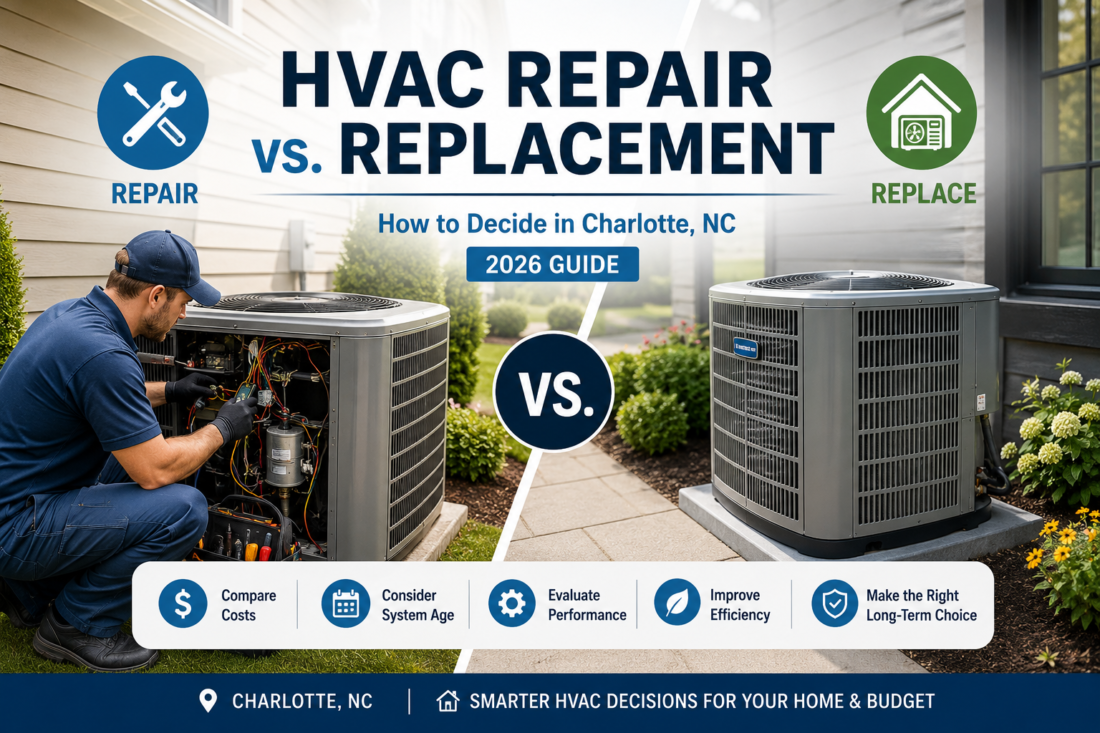
When your HVAC system stops cooling properly, starts making unusual noises, or requires repairs more often than it used to, one important question comes up:
Should you repair the system or replace it?
For some Charlotte homeowners, a relatively inexpensive repair can keep an otherwise reliable HVAC system running for years. For others, spending thousands of dollars on an aging system may not make sense when replacement is becoming inevitable.
The right decision depends on more than the price of one repair. You should consider the age and condition of the system, its repair history, energy efficiency, comfort problems, expected future repairs, and the cost of a replacement.
This guide explains how to compare HVAC repair vs. replacement in Charlotte, NC, including typical repair costs, replacement costs, system age, major component failures, efficiency, and questions to ask before making a decision.
HVAC Repair vs. Replacement at a Glance
| Situation | Repair May Make Sense | Replacement May Make Sense |
|---|---|---|
| System age | Relatively newer system | Older system with declining reliability |
| Repair frequency | Occasional repair | Frequent or recurring repairs |
| Repair cost | Relatively inexpensive | Major repair costing a substantial amount |
| System performance | Still provides reliable comfort | Struggles to maintain comfortable temperatures |
| Energy efficiency | Energy use remains reasonable | Rising energy bills or poor efficiency |
| Major components | Most components remain healthy | Compressor, coil, heat exchanger, or other major component is failing |
| Parts availability | Parts are readily available | Parts are difficult or expensive to obtain |
| Ductwork | Existing ducts are in good condition | Major ductwork problems are present |
| Long-term outlook | Several more years of service are realistic | Additional major repairs are increasingly likely |
There is no single age or dollar amount that automatically means an HVAC system should be replaced.
The best decision comes from looking at the overall condition and expected future cost of the system.
When Does HVAC Repair Make More Sense?
Repair is often the better financial choice when your HVAC system is otherwise performing well and the problem is limited to one component.
Consider repairing the system when:
- The equipment is relatively new.
- The system has generally been reliable.
- The problem is limited to one component.
- The repair cost is manageable.
- The system still provides consistent heating and cooling.
- Energy consumption has not changed significantly.
- The system does not have a history of repeated failures.
- The contractor expects the repair to provide meaningful additional service life.
For example, replacing a failed capacitor, thermostat, or other relatively inexpensive component may be much more economical than replacing the entire HVAC system.
The key is to evaluate the whole system, rather than assuming that one failed part means the entire system needs replacement.
When Does HVAC Replacement Make More Sense?
Replacement becomes more attractive when an HVAC system has multiple problems or when a major repair is likely to be followed by additional failures.
You may want to consider replacement if:
- The system is older and repairs are becoming more frequent.
- Major components are failing.
- The system struggles to maintain comfortable temperatures.
- Your home has recurring hot or cold spots.
- Energy bills have increased without a major change in usage.
- Replacement parts are becoming difficult or expensive to source.
- The system has become unreliable.
- The expected repair cost is a substantial portion of the replacement cost.
- You are already considering major ductwork or electrical modifications.
Replacement does not necessarily mean buying the most expensive system available.
The new equipment should be properly sized for the home and matched to your comfort requirements, budget, and expected length of ownership.
How Old Is Too Old for an HVAC System?
There is no universal age at which every HVAC system should be replaced.
A well-maintained system can sometimes continue operating reliably for years, while a poorly maintained system may require replacement much earlier.
Age becomes more important when combined with:
- Frequent breakdowns
- Increasing repair costs
- Declining efficiency
- Poor temperature control
- Refrigerant problems
- Major component failures
- Difficulty finding replacement parts
Instead of asking only:
“How old is my HVAC system?”
Ask:
“How much will it cost to keep this system operating reliably over the next several years?”
That question provides a much better basis for deciding whether to repair or replace.
How Much Does HVAC Repair Cost in Charlotte, NC?
In Charlotte, homeowners can expect HVAC repair costs to vary considerably depending on the failed component, system type, accessibility, labor, and whether emergency service is required.
A typical repair may cost anywhere from a relatively small service charge to several thousand dollars for major component work.
Some common repair costs include:
| HVAC Repair | Typical Charlotte Cost |
|---|---|
| HVAC service call | $95–$245 |
| AC tune-up | $70–$195 |
| Capacitor replacement | $95–$245 |
| Thermostat replacement | $145–$340 |
| Circuit board | $95–$585 |
| Fan motor | $95–$680 |
| Blower/fan motor | $195–$680 |
| Heat exchanger | $95–$1,460 |
| Duct cleaning | $245–$975 |
| Duct repair | $485–$1,950 |
These figures are planning ranges, not guaranteed prices. Actual costs can vary depending on the equipment, parts availability, accessibility, labor requirements, and exact cause of the problem.
For example, replacing a capacitor can be relatively inexpensive, while repairing a major component can cost thousands of dollars.
That difference can completely change the repair-versus-replacement calculation.
How Much Does HVAC Replacement Cost in Charlotte?
A typical HVAC replacement in Charlotte costs approximately $6,000 to $12,000 when new ductwork is not required. Actual projects can vary considerably based on system type, size, efficiency, equipment, and installation requirements.
For a more detailed breakdown, see our guide:
How Much Does HVAC Replacement Cost in Charlotte, NC?
Central AC Replacement
Central AC replacement can cost several thousand dollars depending on system size, efficiency, home size, equipment type, and installation requirements.
Furnace and AC Replacement
Replacing both a furnace and central AC generally costs more than replacing a single component.
The final price depends on the equipment selected, installation requirements, efficiency ratings, ductwork, electrical work, and other project details.
New Ductwork
If your existing ductwork is damaged, poorly designed, leaking, or unsuitable for the new system, the project can become significantly more expensive.
New ductwork can add several thousand dollars to an HVAC replacement depending on the size and complexity of the home.
A complete HVAC replacement that also requires substantial new ductwork can therefore exceed the price of a straightforward equipment change-out.
Is the 50% HVAC Repair Rule Reliable?
You may have heard the recommendation that homeowners should replace an HVAC system when a repair costs more than 50% of the price of a new system.
This can be a useful starting point, but it should not be treated as a strict rule.
For example, imagine that:
- Your existing system is relatively reliable.
- A repair costs $2,000.
- A new system costs $8,000.
- The repair is expected to provide several more years of service.
Repairing the system could still make financial sense.
Now consider a different situation:
- Your system is already old.
- You have experienced several recent failures.
- A compressor or coil has failed.
- Another major component could fail soon.
In that situation, spending another $2,000 or $3,000 on repairs may be harder to justify.
The better approach is to consider:
Repair cost + system condition + repair history + expected future repairs + replacement cost
together.
How Energy Efficiency Changes the Decision
An older HVAC system may continue working while becoming increasingly expensive to operate.
If your system has experienced:
- Higher electricity consumption
- Longer operating cycles
- Poor cooling performance
- Uneven temperatures
- Increasing humidity
it may be worth comparing its operating costs with those of a newer system.
However, higher efficiency does not automatically mean replacement will pay for itself quickly.
The potential financial benefit depends on:
- Current energy consumption
- Current electricity rates
- Existing system efficiency
- Proposed replacement efficiency
- Home characteristics
- How many years you expect to remain in the property
- Upfront replacement cost
If replacement is being considered, ask the contractor for the exact equipment model numbers and efficiency ratings rather than relying only on terms such as “high efficiency.”
Charlotte’s Climate and the Repair-or-Replace Decision
Charlotte’s hot and humid summers put substantial demand on residential cooling systems.
A system that is technically functioning may still struggle with:
- High indoor humidity
- Uneven cooling
- Long cooling cycles
- Poor airflow
- Increasing operating costs
The climate also makes proper system sizing particularly important.
A replacement system should not simply be selected based on the square footage of the house. A qualified HVAC professional should evaluate the home’s characteristics and perform appropriate load calculations before recommending equipment.
Three Examples: Repair or Replace?
Example 1: Relatively New System With a Small Repair
A five-year-old AC system stops working because of a failed capacitor.
The repair is relatively inexpensive and the rest of the system is performing normally.
Repair is probably the more sensible option.
There is little reason to replace an otherwise healthy system because of one relatively inexpensive component.
Example 2: Older System With a Major Repair
An older AC system develops a major compressor problem.
The repair could cost several thousand dollars, while a complete replacement would provide new equipment, a new warranty, and potentially improved efficiency.
Replacement deserves serious consideration.
The homeowner should compare the complete repair estimate with at least one or two replacement proposals before making a decision.
Example 3: Aging System With Repeated Repairs
An older HVAC system has required several repairs over the last few years.
It now has another major problem, while the home continues to experience uneven temperatures and increasing operating costs.
Replacement may provide better long-term value.
The decision isn’t based on age alone. The combination of repeated repairs, declining performance, operating costs, and another major failure makes replacement more compelling.
What Should You Ask an HVAC Contractor?
Before approving either a major repair or complete replacement, ask the contractor these questions.
1. What exactly failed?
Ask the technician to explain the problem in straightforward terms.
If possible, request photos or other evidence showing the failed component.
2. Can the failed component be repaired or replaced?
Some components can be replaced without replacing the entire HVAC system.
3. How much will the repair cost?
Request a written estimate that clearly identifies parts, labor, refrigerant, materials, and other applicable charges.
4. What is the expected remaining life of the system?
A contractor cannot guarantee exactly how long an aging system will last, but they can explain its current condition and identify other components that may require attention.
5. What would replacement cost?
Even if you decide to repair the system, getting a replacement estimate can help you understand the alternative.
6. What equipment would you recommend?
If replacement is recommended, ask for the exact model number, system capacity, efficiency rating, warranty, and installation scope.
7. Is ductwork or electrical work required?
Ask whether additional work is included in the estimate or would be charged separately.
8. Are permits included?
Ask who will obtain any required permits and whether their cost is included in the proposal.
How to Compare HVAC Repair and Replacement Quotes
Don’t compare quotes based solely on the final dollar amount.
For a repair quote, check:
- Exact failed component
- Parts cost
- Labor
- Refrigerant or other materials
- Repair warranty
- Additional recommended repairs
- Total price
For a replacement quote, check:
- Manufacturer
- Exact model numbers
- System capacity
- Efficiency rating
- Indoor and outdoor equipment
- Thermostat
- Removal of old equipment
- Ductwork
- Electrical work
- Permits
- Labor
- Warranty
- Total installed price
If two contractors recommend completely different solutions, ask them to explain why.
A good HVAC decision should be based on the condition and requirements of your home, not simply the lowest quote.
Repair or Replace? A Simple Decision Framework
If you’re unsure what to do, work through these questions:
Is the system otherwise reliable?
If yes, repair may be reasonable.
Is the repair relatively inexpensive?
If yes, repair may make sense.
Is the system experiencing repeated failures?
If yes, replacement becomes more attractive.
Is a major component failing?
Compare the repair estimate with the cost of replacement.
Is the system inefficient or struggling to maintain comfort?
A replacement may provide better long-term value.
Are you planning to stay in the home for many years?
A new system may make more financial sense if you expect to benefit from it for a long period.
There is no single formula that works for every Charlotte homeowner.
The best decision comes from comparing the current system’s condition with the cost and expected benefits of replacement.
Repair vs. Replacement: Which Option Is Better?
In general, repair is usually worth considering when the system is relatively reliable, the problem is isolated, and the repair cost is reasonable.
Replacement deserves more consideration when the system is aging, repairs are becoming frequent, major components are failing, or the expected cost of continued repairs is becoming difficult to justify.
A useful way to think about the decision is:
Don’t ask only how much today’s repair costs. Ask how much it may cost to keep the entire system reliable over the next several years.
That broader perspective can help prevent homeowners from repeatedly spending money on an aging system without considering the long-term alternative.
Frequently Asked Questions
Should I repair or replace my HVAC system?
Repair may be better when the system is relatively reliable and the problem is inexpensive to fix. Replacement becomes more attractive when repairs are frequent, major components are failing, or the system is becoming expensive to operate.
Is it worth repairing a 10-year-old HVAC system?
Possibly. A 10-year-old system does not automatically need replacement. Consider its condition, repair history, efficiency, refrigerant situation, and the expected cost of future repairs.
How much does HVAC repair cost in Charlotte?
HVAC repair costs in Charlotte vary depending on the type of problem, equipment, parts, labor, and accessibility. Minor repairs can cost a few hundred dollars, while major component repairs can cost significantly more.
How much does HVAC replacement cost in Charlotte?
A typical HVAC replacement in Charlotte costs approximately $6,000 to $12,000 when new ductwork is not required. More complicated installations can cost substantially more.
Should I replace my HVAC system if the compressor fails?
Not necessarily. Compressor repairs or replacements can be expensive, so compare the repair estimate with the system’s age, repair history, overall condition, and the cost of installing a new system.
Does a new HVAC system reduce energy bills?
It can, particularly when replacing an older or inefficient system with properly sized modern equipment. Actual savings depend on the existing system, replacement efficiency, home characteristics, usage, weather, and electricity rates.
Should I get more than one HVAC quote?
Yes. Comparing multiple written proposals can help you understand whether contractors are recommending comparable equipment and installation work. It can also reveal significant differences in project scope.
Should I repair my HVAC system before selling my house?
It depends on the system’s condition and your plans for the property. A major replacement may not always provide enough return before a sale, while repairing an obvious failure can help maintain the home’s marketability. Discuss the options with your real estate professional and HVAC contractor.
Final Takeaway
The decision between HVAC repair and replacement in Charlotte isn’t simply about the age of the system or the price of one repair.
Consider the repair cost, system age, repair history, efficiency, comfort, major component condition, parts availability, and replacement cost together.
A small repair on a reliable system can be a smart investment.
A major repair on an aging system with a history of breakdowns may be a sign that replacement deserves serious consideration.
Before making a major decision, get a clear diagnosis and compare the cost of repairing your current system with the cost of replacing it.
Need Help Comparing Your HVAC Options?
If you’re unsure whether your Charlotte HVAC system should be repaired or replaced, getting a professional assessment can help you understand your options.
CarolinaHomesPro helps Charlotte homeowners research HVAC costs, compare options, and make more informed decisions about home heating and cooling.
Get Free HVAC Quotes in Charlotte
1 thought on “HVAC Repair vs. Replacement in Charlotte, NC: How to Decide (2026 Guide)”